
Content index
With Hyper-Depreciation, companies purchasing new machinery or technological systems can calculate a higher tax cost on their balance sheet than the actual cost.
For income tax purposes only, the value of the assets is "increased" by law. This increases the depreciation or lease payments deductible each year, resulting in significant tax savings (IRES and IRPEF) over the entire depreciation period of the asset.
What changes in 2026?
The 2026 Budget Law (Law 199/2025, art. 1, paragraphs 427-436) reintroduced Hyper-Depreciation for the three-year period 2026-2028, marking a fundamental change in logic compared to previous years.
- Goodbye to the F24 tax credit: the benefit is no longer received in the form of a tax credit to be used to offset F24 payments, contributions, or other taxes. Instead, it becomes a super-deduction from taxable income.
- Impact on IRES and IRPEF: the tax savings directly impact income taxes (IRES/IRPEF), while not relevant for IRAP purposes.
- Importance of tax capacity: since it is a deduction, companies with sufficient taxable income obtain an immediate tax saving; for companies temporarily in loss, the deductible portion is deferred to subsequent years when they return to profit.
- Progressive tax brackets: the cost increase is applied progressively on an annual basis (up to a maximum of €20 million per production facility).
Up to €2.5 million - 180% increase (280% of the asset's value is depreciated).
From €2.5 to €10 million - 100% increase (200% depreciation).
From €10 to €20 million - 50% increase (150% depreciation).
Investments undertaken under the old regime retain the F24 tax credit provided that interconnection occurs by June 30, 2026.
Beyond this date, the project falls under the new Hyper-Depreciation rules.
Which interventions and technologies are included and who are the beneficiaries?
All companies of any size and legal sector with headquarters or production facilities in Italy are eligible for the incentive, provided they comply with workplace safety regulations and pay contributions (DURC).
Eligible interventions and technologies
Goods purchased between January 1, 2026, and September 30, 2028, must be interconnected to company management systems or the network and fall into the following categories.
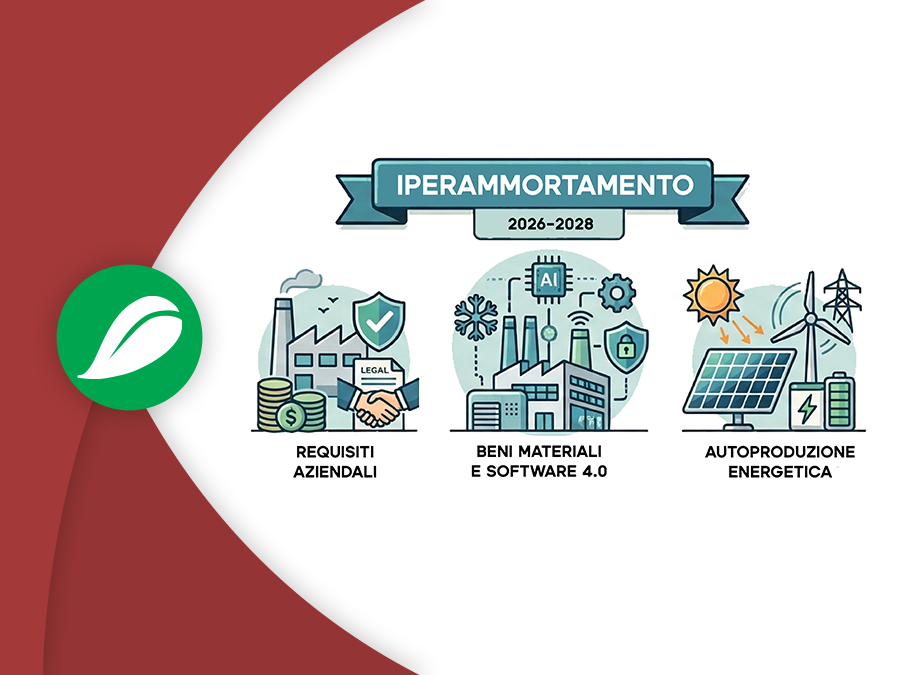
- Industry 4.0 tangible assets: industrial machinery, technological systems, and HVAC systems serving production processes, intelligent solutions for monitoring and improving energy or water consumption efficiency, AI hardware, edge computing, and OT/IT cybersecurity.
- Industry 4.0 intangible assets and software: energy dashboarding, Artificial Intelligence platforms (LLM and Agentic AI), Carbon Footprint (LCA) calculation software, Digital Twins, and Digital Product Passport systems.
- Self-production from renewable sources (RES): photovoltaic and wind power plants, energy storage systems (BESS), transformers, and electrified process heat systems for self-consumption.
Focus on Photovoltaic: only high-efficiency modules manufactured in the EU (cells ≥ 23.5% or ≥ 24% for bifacial heterojunction/tandem cells) and with a production capacity of up to 105% of the previous year's consumption are eligible.
The steps to receive the incentive and the role of MIR Group
To benefit from the Hyper-Depreciation with complete tax security, you must follow a specific procedure managed through the GSE (Energy Services Manager) platform.
- Feasibility analysis and design: verification of Industry 4.0 requirements, cost caps (€/kW), and system sizing based on company consumption.
- Preliminary notification to the Energy Services Authority (GSE): electronic submission of the initial notification to reserve the benefit before or at the start of the investment.
- Confirmation notification: notification of the deposit payment of at least 20% of the cost of the project.
- Completion and certification: submission of final documentation upon completion of the work, accompanied by the sworn Industry 4.0 technical report and the accounting certification issued by a certified auditor or professional.
- Annual monitoring: submission of periodic supplementary communications to maintain the benefit over the years.
Tackle the energy transition "turnkey" with MIR Group
The complexity of the regulations and the steps involved in the GSE portal require an integrated approach, combining technical and procedural expertise.
MIR Group presents itself as a single partner for Sustainable Urban Regeneration and business transition.
- Engineering and systems: we design and install energy efficiency solutions, advanced AI-based remote management systems, and high-efficiency photovoltaic systems, including next-generation BIPV systems.
- Bureaucratic and tax support: assistance at every stage of the process, from preliminary analysis to managing GSE communications, up to the issuance of the Technical Appraisal and accounting certification.